



Permian’s mission has always been rooted in a simple but profound belief: that protecting forests means protecting the intricate web of life within them. Nowhere is this more vividly illustrated than in the primate communities of Borneo, where the health of an entire ecosystem can be measured in the calls of gibbons echoing through the canopy, or the slow, deliberate movement of an orangutan through the treetops. Primates are not merely inhabitants of these forests; they are architects of them, shaping the landscapes that countless other species, including our own, depend upon. It is this understanding that drives Permian’s biodiversity work at Kuamut in Sabah, Malaysia, and Katingan in Kalimantan, Indonesia, and that gives our conservation efforts their deepest sense of purpose.
In an earlier article, we explored the vital role that primates play in tropical forests. The key finding was that primates act as keystone species, meaning they have an outsized influence on the health and shape of the forest around them. They do this largely through seed dispersal; as primates move through the forest eating fruit, they carry seeds with them and deposit them elsewhere, helping to determine which plants grow where and in what numbers. This in turn has a knock-on effect on the broader ecosystem, influencing its biodiversity, the amount of plant life it supports, and how productive it is overall. A good example of this is the fig tree, a critical food source for many animals, which relies on primates and birds to spread its seeds. Building on that earlier piece, this article takes a closer look at the primate populations at two of Permian’s project sites: Kuamut in Sabah, Malaysia, and Katingan in Kalimantan, Indonesia. Primates at Permian’s sites in Brazil and Colombia will be covered in a future article. Both sites are home to a remarkable variety of primate species, and our understanding of them continues to grow each year as Permian’s biodiversity programme expands.
Borneo (Malaysia and Indonesia)
There are about 20 species of primates in Borneo but many of these are regionally distributed and some of them do not swim, which has caused evolutionary processes to result in greater genetic diversity.
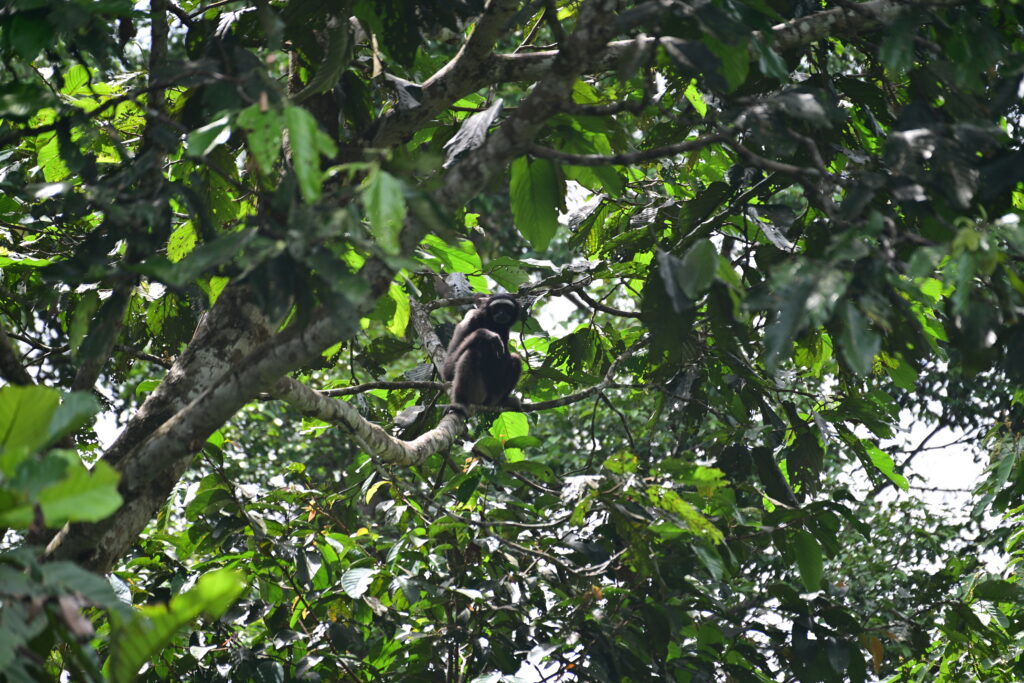
In Borneo there are four gibbon species, roughly distributed in the north-east, north-west, south- east, and south-west. They are all morphologically distinct, separated by mountain ridges and rivers that they do not cross. Orangutans similarly do not swim, but there are three subspecies, with a missing area in the south-east. Relatively recently a population of about 50 animals was discovered in the south-east, which may represent an undescribed taxon or an introduced population. The strength of morphological differences may be the reason that the gibbons have been described as species and the orangutans as subspecies, when the evolutionary barriers they face seem to be the same. Kuamut and Katingan each have their own species of gibbon and its own subspecies of Orangutan. In Sarawak, a potential future Permian project site, the local gibbons and orangutans are rare due to the indigenous traditions of primate hunters. Abbot’s Gibbon and the nominate pygmaeus subspecies of orangutan are being found in smaller fragments of forest than previously expected and it is hoped that both will exist in a new Permian project area.
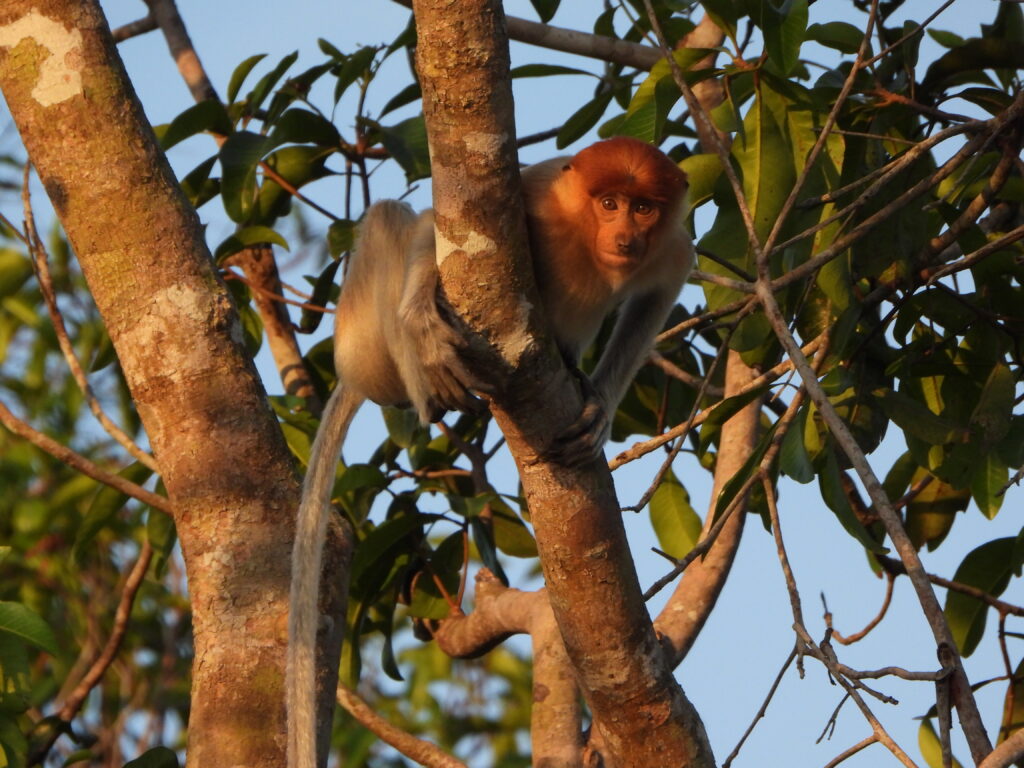
There are three large monkeys in Borneo, which tend to occur along the river valleys, and all three are at both Kuamut and Katingan. They are the Proboscis Monkey, Long-tailed Macaque, and Sunda Pig-tailed Macaque. The langurs are said not to swim and are regionally distributed, but their distributions are not similar to these three. The Maroon Langur, (Presbytis rubicunda), occurs across the whole island and has five morphologically diverse subspecies. Different subspecies occur at both Katingan and Kuamut. The Silvery Langur, (Trachypithecus cristatus), tends to occur near coastlines, and has been recorded at Kuamut but not yet at Katingan where its occurrence is expected. There are four species of grey Langurs in central and northern Borneo, and the one at Kuamut is the Sabah Grizzled Langur, (Presbytis sabana). Further west, Hose’s Langur is expected. Sadly, the stones found in Langurs’ stomachs (bezoars) are valued in traditional Chinese medicine, so there can be considerable hunting pressure. The last species of langur of note is in Sarawak, the Banded or Cross-marked Langur, (Presbytis chrysomelas). This species is restricted to areas near the coast of Sarawak and one site in southern Sabah. It is Critically Endangered due to the significant human populations in its range. The species is quite morphologically varied and may be a combination of species, all with tiny populations.
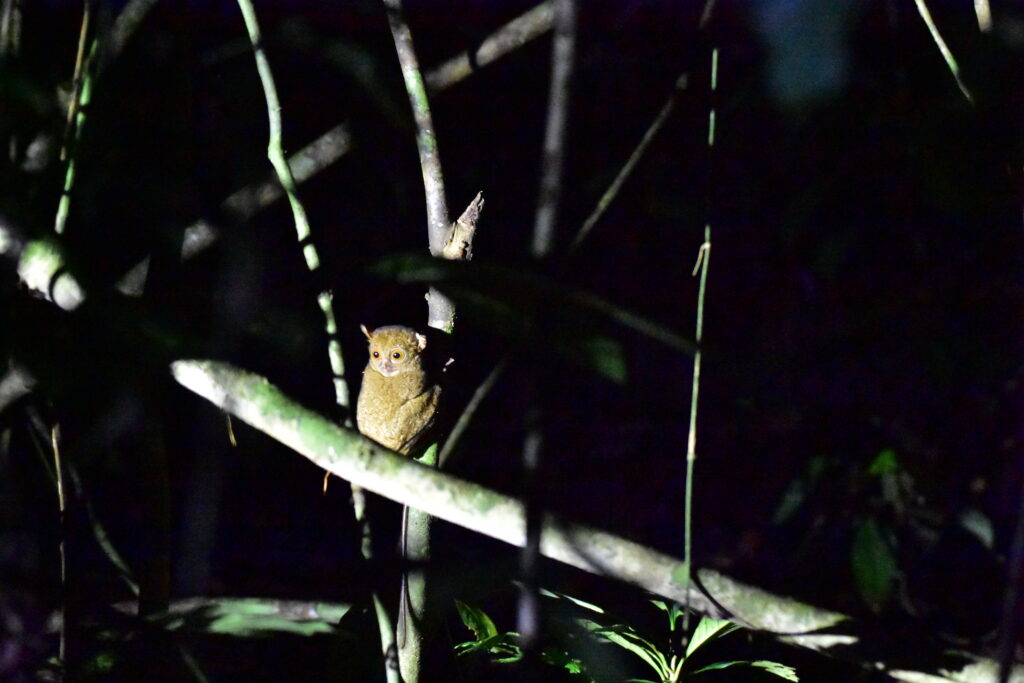
Recently it has been realized that the Slow Lorises of Borneo are quite diverse and there are now five recognized species. Their distributions are uncertain, but the assumption is that they are generally geographically separated, but with two sympatric species in the south-west, possibly including Katingan. There is thought to be only one Slow Loris species at Kuamut, but further investigation is required. The nocturnal Tarsiers were long considered to be one species,
the Western Tarsier, (Cephalopachus bancanus), in Borneo, Sumatra and the mainland but now with better taxonomic identification tools, there seems to be at least 15 species. The former Western Tarsier has been split into four species, two each at Kuamut and Katingan.
In total, there seem to be nine species of primates at Kuamut and eight to ten at Katingan. Both indicative of healthy, functioning, tropical forests. Because we have an abundance of primates at our current Asian project sites, emphasizing their ecology as keystone species and continued protection is an obvious area of focus for present and future Permian activities.
The primate diversity documented across Permian’s Asian project sites is more than a testament to the richness of Borneo’s forests. It is a sign that conservation, when done with care and commitment, works. With nine species recorded at Kuamut and up to ten at Katingan, these thriving communities tell a story of resilience and possibility. As Permian continues to expand its biodiversity programme, deepen and refine its baseline data, and look ahead to future project sites in Brazil and Colombia, the presence of these remarkable animals reminds us of what is at stake and what can be achieved. There is genuine cause for optimism, and we are only just beginning.

Photos courtesy of Dr. Sunarto and RMU
For more news click HERE
Katingan Mentaya Project page HERE
Kuamut Rainforest Conservation Project page HERE