



In September 2025, the Natural Climate Solutions Alliance (NCSA), in partnership with the World Business Council for Sustainable Development (WBCSD), organized the webinar series Nature in Action: Brazil’s Natural Climate Solutions. Permian Global, represented by Jessé Burlamaque, Geographic Information Systems (GIS) specialist, and Denison Trindade, Regional Manager for the Amazon, presented the case Resilient Forests: Defending the Amazon in an Era of Forest Fires.
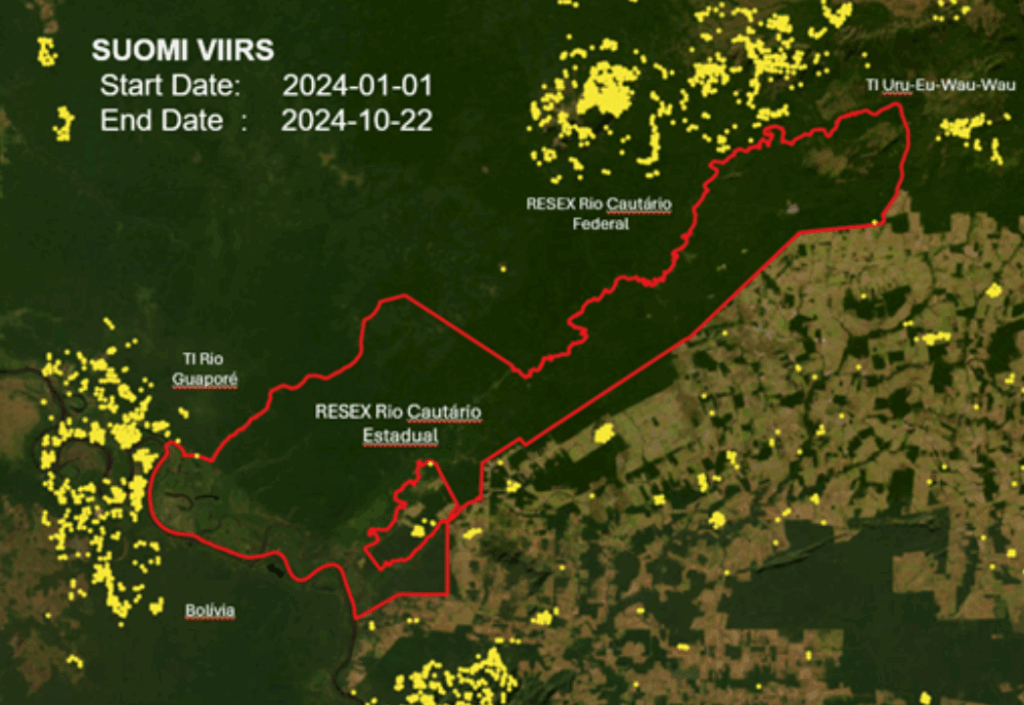
The webinar showcased a successful forest protection strategy based on Permian Brasil’s experience with the communities of the Rio Cautário State Extractive Reserve (RESEX). The case emphasized the role of technology and collaboration with local actors, as well as the challenges of defending communities and forests against the growing number of fires in the region. The year 2024 was marked as a period of extreme heat, during which fires affected an area of the Amazon equivalent to the size of California.
These increasingly frequent fires threaten local communities and accelerate climate change by destroying biodiverse forests. As a result, fire mitigation has become a conservation priority, with organizations such as Permian Brasil—a subsidiary of Permian Global—implementing local planning, satellite monitoring, and specialized teams trained to prevent and combat fires in the region.
Tackling Fires in the Amazon: Smart Protection on the Frontier of Conservation
In a presentation rich with insights and results, our experts demonstrated that the reality of forest protection in the Amazon goes far beyond the romanticized narratives we often hear. Effective conservation, they argued, is built on the combination of advanced technology and traditional knowledge of the land—a partnership that has yielded remarkable results in protecting the Rio Cautário RESEX, an area of more than 146,000 hectares of forest in Rondônia.
In his introduction, Jessé Burlamaque provided a current overview of the Amazon rainforest—both from the perspective of the climate changes experienced by local populations and the ecosystem services the forest provides. The Amazon stores approximately 123 million tons of carbon, equivalent to three times total annual global emissions. This is not just about keeping carbon locked away, but about the forest’s dynamic role in the constant cycle of CO₂ emissions and absorption that regulates the global climate.

Climate Change and New Challenges
According to our expert, in recent years we have witnessed major transformations in the Amazon. Dry seasons have become longer and more severe, large rivers have begun to dry up, and navigation has become increasingly difficult for local communities. In 2024, the region experienced one of the most extreme fire seasons in the past two decades.
This situation has created a worrying feedback loop in which forest loss and degradation reduce moisture cycling, leading to more intense droughts that, in turn, increase fire susceptibility. Affected areas are expanding into previously protected regions, threatening the ecosystem’s integrity. For this reason, a no-burn strategy is the most effective way to maintain forest resilience, as burned areas produce vegetation that is more prone to ignition and spread.
Technology and Traditional Knowledge: A Winning Partnership
Drawing on the case study of the Rio Cautário RESEX in Rondônia—where an innovative forest conservation design approach has been developed—Jessé shared valuable lessons on combining cutting-edge technology with the traditional knowledge of the 92 families living in the region. According to him:
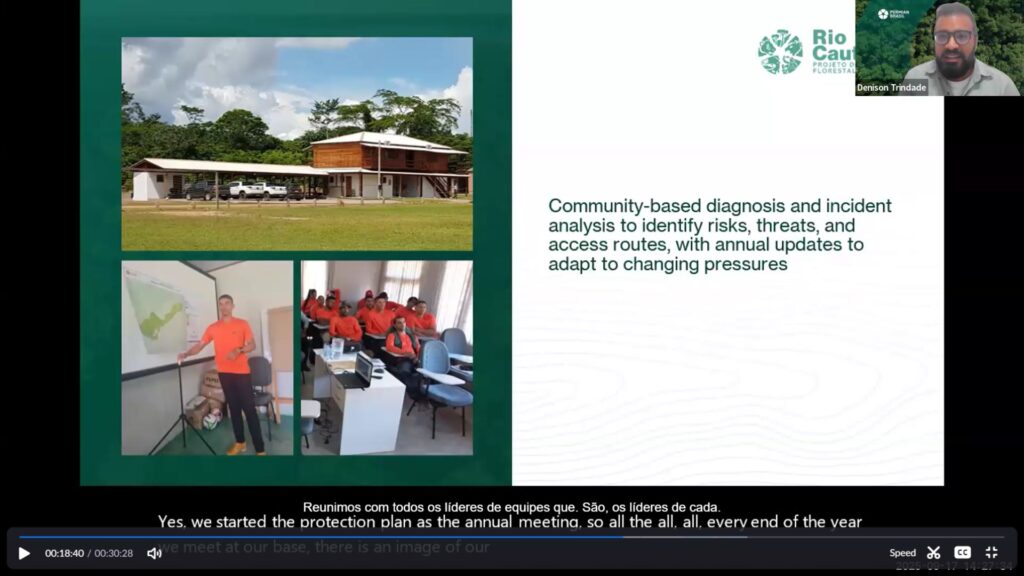
Planning begins with annual meetings involving all community leaders to create a risk map that zones the reserve according to threat levels.
Teams are recruited locally and undergo rigorous training, including physical and psychological evaluations and hands-on practice with controlled burns.
The project integrates these local capacities with advanced geotechnical tools, including real-time alerts, fire-spread maps, and thermal drones operated by the communities themselves.
The OroraTech platform issues hourly alerts, allowing rapid response to hotspots.
During the extreme fire year of 2024, even under intense pressure from hotspots around the reserve, this integrated protection kept the fires outside its boundaries—demonstrating the effectiveness of a collaborative approach that unites technology and local knowledge.
Integrated Operations and Effective Communication
In the second part of the webinar, Denison Trindade, our Amazon Regional Manager, demonstrated that effective forest protection depends not only on patrolling, but on an integrated system that values those who know the territory best: the local communities themselves.
Denison detailed the project’s successful experience in recruiting and training a community-based team of environmental defense agents, equipped with water and land vehicles for rapid deployment, structured procedures, and state-of-the-art protection and firefighting tools. The operation also includes a situation room that centralizes information from multiple sources — technological platforms, community reports, and technical data.
The field teams maintain constant communication via internet or satellite phone, receiving real-time strategic information for fire prevention and suppression, ensuring effective coordination and enhanced operational safety. This same situation room also shares information and coordinates joint actions with local command-and-control agencies, benefiting not only the reserve but also its surrounding areas through the integration of technology and community networks.
The experience in the Rio Cautário RESEX demonstrates that it is possible to protect tropical forests even under extreme climate conditions. The combination of technological innovation and local knowledge creates a replicable model for other regions, proving that projects like this go beyond environmental protection — they are investments in global climate stability, biodiversity preservation, and the well-being of the communities that depend directly on these ecosystems.
Watch the webinar “Resilient Forests: Defending the Amazon in an Age of Wildfires” here.
For more from Permian Brasil click HERE
For more news from Permian Global click HERE