



17 December 2022 – The call that changed everything
It was a Tuesday. As I was reviewing notes on wildlife monitoring, the phone rang. It was a call from Colombia’s National Natural Parks: they would be visiting our protected area, located in the municipality of La Macarena, Meta, to assess whether we met the ecological and legal criteria to be officially recognised as a Civil Society Nature Reserve (RNSC). The message was clear: we were on the verge of a decisive leap toward the legal protection of a biodiverse territory at the heart of the Colombian Amazonian piedmont.
19 January 2023 – First encounter with a living ancestor
Samanta and Néstor, technicians from the National System of Protected Areas, arrived in La Macarena for the official visit. We met before heading into the field to show them maps and boundaries. As we walked the reserve’s limits, surrounded by saddle-back tamarins (Saguinus inustus), red howler monkeys (Alouatta seniculus) and the piercing call of the screaming piha (Lipaugus vociferans), we spent the afternoon hiking through the forest before boarding a canoe and slowly drifting downstream on the Guayabero River.
That’s when it happened. We stepped out of the canoe onto a pale sand island in the middle of the Guayabero, shaped by the transition from the rainy to the dry season. And there it was — an Orinoco Crocodile (Crocodylus intermedius). It was the first sighting since the land had been acquired and declared a reserve. No photographs were taken. Just silence, goosebumps, and a moment of overwhelming awe.
Before us stood a true living fossil, the heir to an unbroken evolutionary lineage over 200 million years old¹. The Orinoco Crocodile is not only the largest freshwater predator in South America — it is a biological remnant of the Mesozoic era, a survivor of mass extinctions and planetary upheaval².
Classified as Critically Endangered (CR) by the IUCN and listed under Appendix I of CITES², fewer than 250 adult individuals are estimated to remain in the wild. That night, from the research hut, we gazed out towards the river as we drifted off to sleep. The eyes of a few reptiles gleamed like floating lanterns in the dark — a result of the tapetum lucidum, a reflective layer that enhances night vision³, vital for hunting in murky environments.
20 January – Conversations, data and an idea
The following day, we continued the visit and shared stories with Samanta, Néstor, and Melquisedec, our park ranger. During the conversation, a little-known fact emerged: the Orinoco Crocodile possesses one of the lowest levels of genetic variability among all crocodilian species⁴ — the result of population bottlenecks caused by decades of overexploitation. As we carried on with the fieldwork, we spotted another individual. This time, we managed to capture a short video, although from a distance, as the reptile had detected our presence. One remarkable trait of crocodiles is their long-distance vision; their vertical pupils contract in intense light, yet their visual acuity is so sharp they can detect subtle movements from over 100 metres away³.
The visit ended on a positive note, and we were left awaiting official confirmation from the National Parks authority regarding our eligibility to be declared a Civil Society Nature Reserve (RNSC). Together with Melquisedec, we also planned a seasonal census to take advantage of the beach stability during the dry season.
February – Science, coffee and vigilance
For two weeks, Melquisedec kept watch from a hilltop, binoculars in hand, a flask of coffee by his side. From 140 metres away, he monitored the sand island and recorded sightings of three adult crocodiles, each between 3 and 4 metres long. Their activity varied depending on weather, human presence, and sunlight. Each day included georeferencing, temperature and humidity measurements, and behavioural observations — posture, movement, alert signs. He also documented fishermen passing by and the sound of motorboats, which disturbed the crocodiles’ routines.
On these temporary beaches, females dig nests 30 to 60 cm deep and lay between 30 and 70 eggs⁵. The sex of the hatchlings is determined by the incubation temperature — a phenomenon known as temperature-dependent sex determination. At 31.6°C, males are more likely to develop; slight deviations up or down produce females⁶.
March – Operation Camera Trap

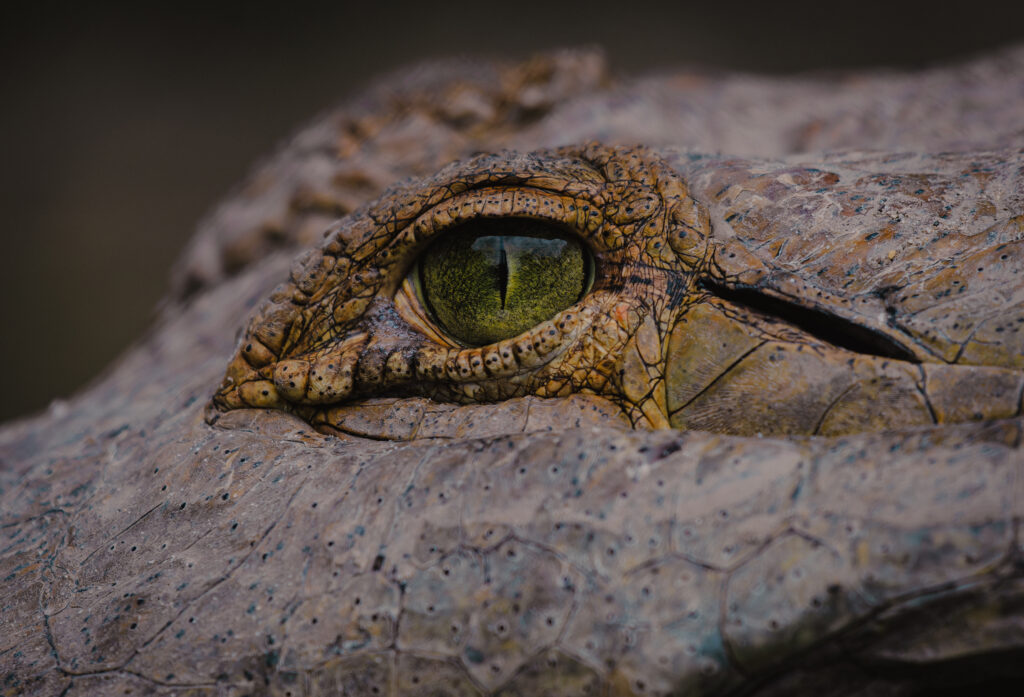
Sandbanks, Guayabero Crocodile Reserve ©Permian Colombia
I returned to La Macarena with a local team: Felipe (environmental educator), Henry (teacher at Nuestra Señora de la Macarena school), and his son Mario, a biology student. At dawn, we set out for the island and installed four camera traps, digging a strategic hide nearby.
The island was unique — pale yellow-white sand at the centre, ringed by a uniform belt of black stones. A natural structure that, curiously, offered physical protection against erosion. We also found human footprints — signs of nest looting for consumption.
Unforgettable encounters and astonishing facts
“Camera 1!” Melquisedec called over the radio. “Crocodile emerging. Going for a fish left by black vultures (Coragyps atratus).” Later, another individual was observed with its mouth open — thermoregulating via the so-called thermal gaping⁷. This behaviour dissipates heat from the brain without overheating the rest of the body. The optimal activity range for this species lies between 30 and 33°C⁸.
We approached silently. At 50 metres, we saw a large male sleeping: legs stretched out, eyes half closed, jaws shut. Possibly in unihemispheric sleep⁹ — a state where one cerebral hemisphere remains alert while the other rests, also seen in birds and cetaceans.
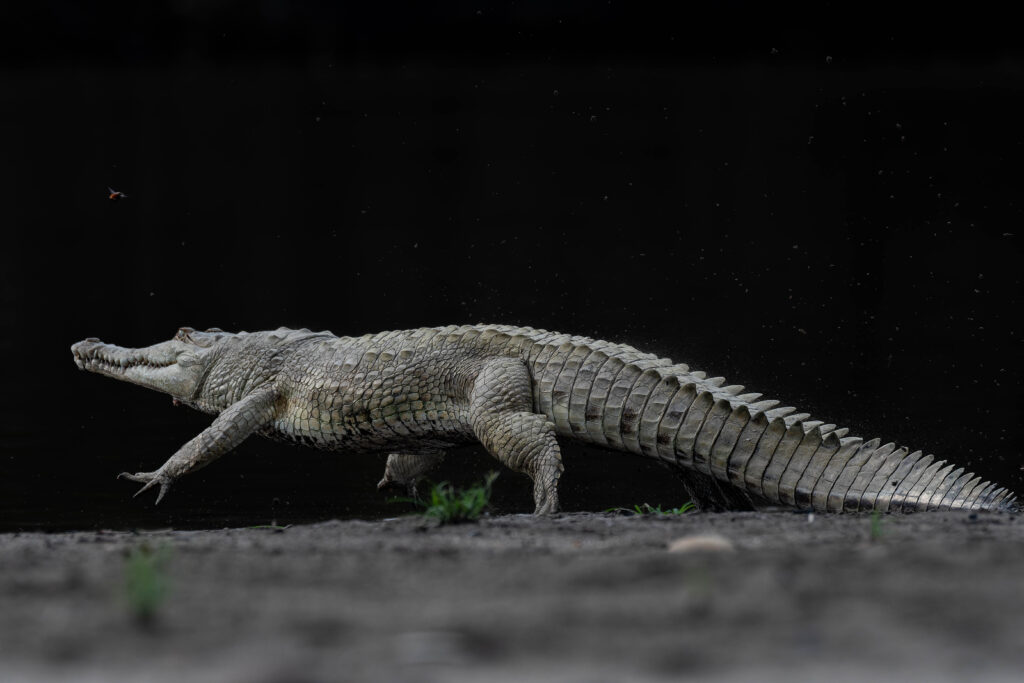
Orinoco crocodile, reptilian gallop ©Juan Carlos Rivas
We had just one chance after a week of trying to capture the perfect shot. A breath, a hand signal, the shutter clicked. It lasted two seconds. That was enough. The crocodile sprang up and dashed into the water at over 17 km/h, using its famous “high walk” gallop¹⁰ — a rare feat among reptiles, allowing for rapid land movement over short distances.
Findings, threats and hope
In just one week, we identified six adult crocodiles, each between 4 and 5 metres long. But we also documented threats: riparian deforestation, pollution, and untimely heavy rains, all of which erode nesting beaches.
Climate change is disrupting the natural hydrological cycle of the Guayabero. If rains arrive early, nests flood — wiping out entire generations. Under optimal conditions, the Orinoco Crocodile can live up to 70 years in the wild¹¹. But the first weeks of life are a race between survival and extinction.
The data collected now fuels our biological education strategies. Felipe brings the story to the classroom; Henry turns the material into educational content, complete with photographs; Mario lived a one-of-a-kind moment: waiting quietly, crawling across the earth, and finding himself astonishingly close to the crocodile. And Melquisedec, ever vigilant, remains the guardian of this stretch of the Guayabero and its majestic forest.
July 2023 – A historic recognition
Six months later, the news arrived via email: the Guayabero Crocodile Reserve was officially registered as Civil Society Nature Reserve No. 063-21. It was more than a bureaucratic step — for the Permian team, it marked the legal creation of a living classroom, open and protected for the community and academia alike.
That day we celebrated not a personal achievement, but a collective pact with life: to protect the King of the Orinoco — the last emperor of a river that still holds its wild soul.

Orinoco crocodile, reptilian gallop ©Juan Carlos Rivas
By: Juan Carlos Rivas Flórez
References
¹ Brochu, C. A. (2003). Phylogenetic approaches toward crocodylian history. Annual Review of Earth and Planetary Sciences, 31, 357–397.
² IUCN. (2023). The IUCN Red List of Threatened Species – Crocodylus intermedius. Retrieved from: https://www.iucnredlist.org/
³ Fritts, T. H. (1982). The tapetum lucidum and vision in Crocodylus. Journal of Herpetology, 16(4), 442–444.
⁴ Venegas-Anaya, M., Crawford, A. J., Páez, V. P., & Densmore, L. D. (2008). Low genetic diversity in the critically endangered Orinoco crocodile (Crocodylus intermedius). Biological Conservation, 141(9), 2017–2027.
⁵ Thorbjarnarson, J. B. (1999). Crocodile tears and skins: International trade, economic constraints, and limits to sustainable use of crocodilians. Conservation Biology, 13(3), 465–470.
⁶ Lang, J. W., & Andrews, H. V. (1994). Temperature-dependent sex determination in crocodilians. Journal of Experimental Zoology, 270(1), 28–44.
⁷ Spotila, J. R., O’Connor, M. P., & Dodson, P. (1977). Thermal ecology of the American alligator and the American crocodile. American Zoologist, 17(1), 225–234.
⁸ Grigg, G., & Kirshner, D. (2015). Biology and Evolution of Crocodylians. Cornell University Press.
⁹ Kelly, M. L., Riehl, C. M., & Siegel, J. M. (2012). Unihemispheric sleep in reptiles? Evidence from a behavioural and electrophysiological study. Sleep, 35(10), 1345–1353.
¹⁰ Webb, G. J. W., & Manolis, S. C. (1989). Crocodiles of Australia. Reed Books.
¹¹ Huchzermeyer, F. W. (2003). Crocodiles: Biology, Husbandry and Diseases. CABI Publishing.
To learn more about the Guayabero Cocodrilo Reserve click HERE
For more news click HERE