



The roar that heralds a story of survival
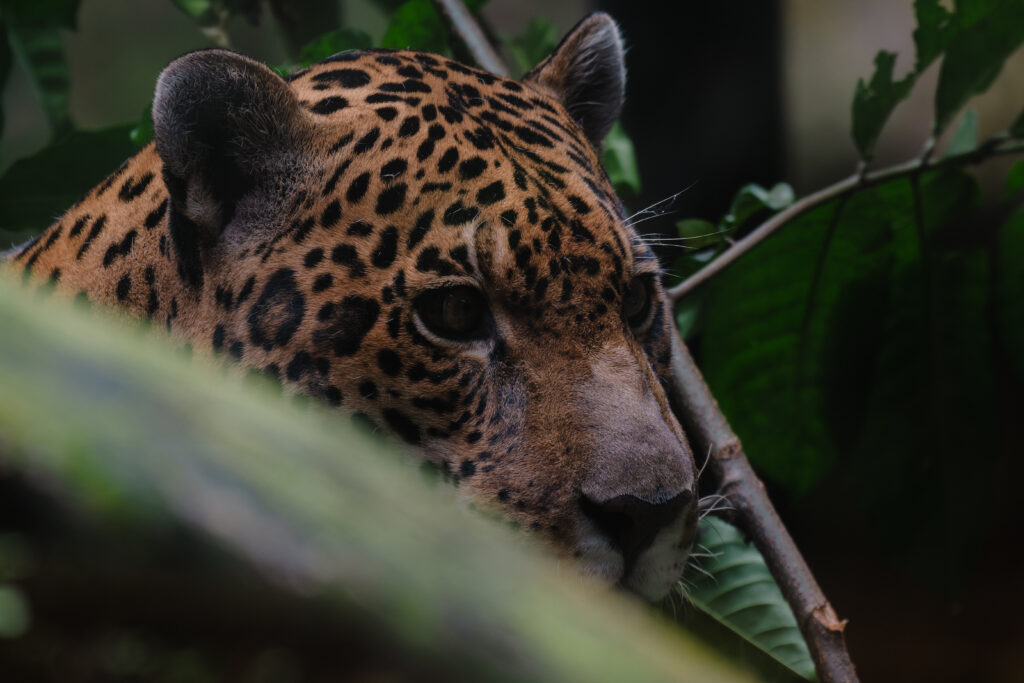
In 2022, deep in the Amazonian night of La Macarena, a low roar sliced through the air like a saw biting into wood. It was the jaguar’s sawing call, a territorial signal that carries for more than two kilometers, making the darkness itself vibrate. At three o’clock in the morning, in the camp of the Guayabero Crocodile Reserve, the roar thundered, even as the forest around remained silent. Years later, in 2025, camera traps finally recorded the majestic male crossing the forest, followed by a direct sighting on the banks of the Guayabero River. That moment marked the beginning of a tale of survival, adaptability, and resilience.
A continental journey: expansion and retreat of the jaguar
Over the centuries, the jaguar ranged from the southern United States to northern Argentina, inhabiting a vast corridor through Central and South America. Yet human expansion and habitat loss forced it to retreat. In the United States, the last individuals are only isolated sightings in Arizona; in Argentina, they persist in fragments such as the Chaco and the Misiones rainforest.
The Colombian mosaic: diversity and population vulnerability
In Colombia, jaguar populations form distinct ecological blocks. The Sierra Nevada de Santa Marta shelters an isolated population in critical danger due to its weak connection with the Serranía del Perijá. In the Chocó biogeographic region, another subpopulation faces similar threats. The Perijá–Catatumbo block, in the north-eastern Andes, is also highly vulnerable. By contrast, the Orinoquía and Amazonia together form the country’s most extensive and genetically connected block, with densities of up to 2 individuals per 100 km².
Brazil: the jaguar stronghold and its unique adaptations
Brazil harbours the largest jaguar populations. In the Pantanal, densities may exceed 6.6 individuals per 100 km². Here, jaguars have developed specialised hunting of caimans (Caiman yacare) and capybaras, and even tolerate human presence in certain protected areas. The Brazilian Amazon functions as a large-scale evolutionary corridor, linking populations from Peru, Colombia, Ecuador, and Venezuela.
Jaguar resilience in the face of habitat loss
Although currently listed as Near Threatened by the IUCN, the jaguar’s history reveals a remarkable ability to adapt to habitat fragmentation, hunting, and human–wildlife conflict.
Life cycle of the Neotropical superpredator
The jaguar (Panthera onca) roams up to 500 km² in search of a mate, guided by chemical and auditory signals. After a gestation of 93 to 105 days, the female gives birth to one to four cubs, which she raises in rotating dens to protect them. At six months, the cubs learn to hunt and climb; between 18 and 24 months, they disperse to establish their own territories.
Physical and sensory adaptations ensuring hunting success and survival
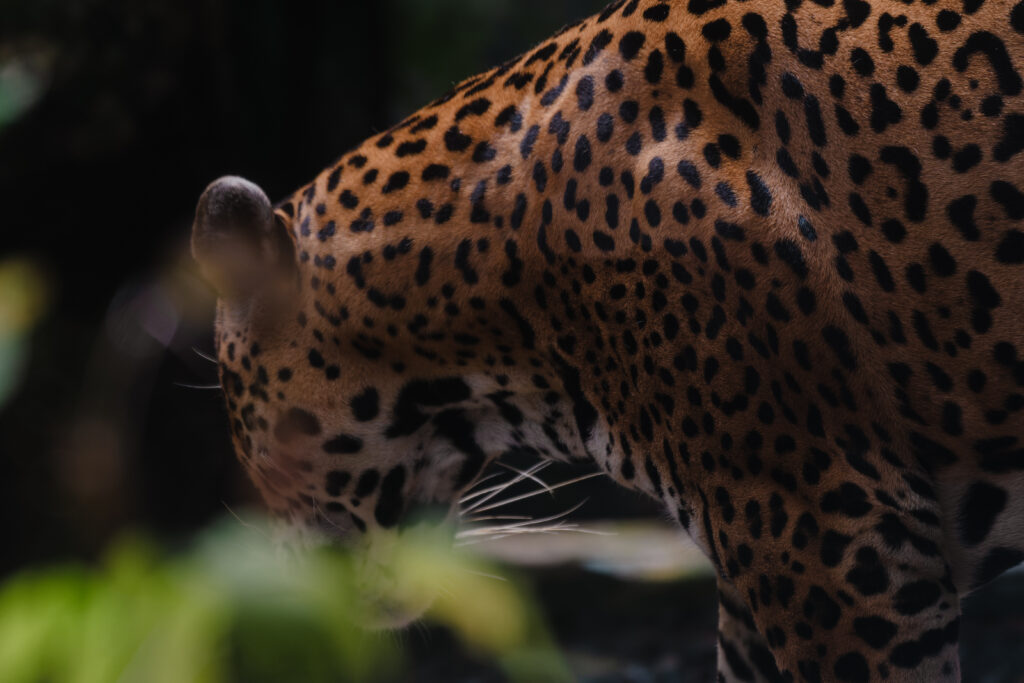
During dispersal, jaguars confront threats and challenges. Their rosette camouflage breaks up their silhouette within vegetation. In dense rainforest, melanism—present in up to 6% of certain populations—enhances their invisibility. Their bite force reaches 1,500–2,000 psi, the strongest among big cats relative to body size, allowing them to crush skulls and shells with ease.
Their night vision, enhanced by the tapetum lucidum and a rod-rich retina, enables them to detect prey over 50 metres away in complete darkness. They can hear frequencies of up to 65 kHz, capturing ultrasonic calls of small mammals. Their sense of smell allows them to construct a chemical map of their surroundings, while advanced spatial memory aids navigation in fragmented habitats.
Master of water: amphibious hunter of the tropics
The jaguar is an exceptional swimmer. It enters rivers and lagoons to hunt capybaras, caimans, and fish weighing up to 3 kg, aided by its hydrophobic fur and powerful thoracic muscles. Its lung capacity, exceeding 2.2 litres, allows underwater ambushes lasting up to 40 seconds.
Local conservation: protection through Project JAGUAMAC
At the Guayabero Crocodile Reserve, Meta, more than 36 hectares have been restored since 2020. During this process, continuous jaguar presence was documented. This led to the creation of Project JAGUAMAC, a community ecological corridor connecting 1,350 hectares of private land, strengthening connectivity across a fragmented landscape. The initiative integrates participatory monitoring, rural education, and community management.
The jaguar as an ecological indicator: strengths and limits
The jaguar symbolises Neotropical ecological resilience and, owing to its large ecological requirements, is often considered an indicator of landscape health. Its presence may reflect ecosystem functionality, corridor integrity, and the effectiveness of conservation strategies. Yet not all jaguar records imply well-preserved habitats or fully functioning ecosystems. Solitary jaguars can persist in fragmented or degraded landscapes, adapting to areas with little forest cover or intense human pressure. In zones of extensive cattle ranching, monocultures, or near towns, displaced individuals survive marginally, exposed to human conflict and with limited access to wild prey. Thus, jaguar presence must be interpreted cautiously and alongside other ecological and social indicators. Conserving the jaguar means not only ensuring its existence but also restoring the conditions that allow its long-term persistence: connected habitats, available prey, and communities engaged in its protection.
Coexistence in shared territories: key to conservation
In regions such as the Orinoquía, Catatumbo, or Chocó, where human communities and jaguars coexist, local knowledge of the cat’s habits becomes vital for reducing conflict. Strategies such as rural education, community monitoring, and non-lethal response protocols have proven effective in reducing retaliatory killings.
A look to the future: the jaguar as an intergenerational legacy
Imagine the year 2075: thanks to today’s efforts, the jaguar still reigns in restored forests. Every individual that survives today is a bridge to the future, proof that coexistence is possible. To conserve the jaguar is to preserve the very soul of the forest—today and tomorrow.
References
Cavalcanti, S. M. C., & Gese, E. M. (2010). Kill rates and predation patterns of jaguars in the southern Pantanal, Brazil. Journal of Mammalogy, 91(3), 722–736. https://doi.org/10.1644/09-MAMM-A-171.1
González-Maya, J. F., Víquez-R, L. R., Arias-Alzate, A., Granados-Peña, R. A., & Ceballos, G. (2020). Estado de conservación del jaguar en Colombia. WCS Colombia.
Heffner, R. S., & Heffner, H. E. (1985). Hearing range of the domestic cat. Hearing Research, 19(1), 85–88. https://doi.org/10.1016/0378-5955(85)90100-5
Hoogesteijn, R., & Mondolfi, E. (1993). Cattle predation by jaguars and pumas in Venezuela. Mammalia, 57(3), 379–391. https://doi.org/10.1515/mamm.1993.57.3.379
IUCN. (2024). Panthera onca. The IUCN Red List of Threatened Species 2024. https://www.iucnredlist.org/species/15953/50659951
Leyhausen, P. (1979). Cat behavior: The predatory and social behavior of domestic and wild cats. Garland STPM Press.
Morato, R. G., Stabach, J. A., Fleming, C. H., Calabrese, J. M., De Paula, R. C., Ferraz, K. M. P. M. B., Kantek, D. L. Z., Miyazaki, S. S., Pereira, T. D. C., Araujo, G. R., Paviolo, A., Lima, F., Cullen, L., Sana, D. A., Ramalho, E. E., Carvalho, R. A., Soares, F. H. S., Zimbres, B., Silva, L. C., … Pardo, J. M. (2016). Space use and movement of a neotropical top predator: The endangered jaguar. PLoS ONE, 11(12), e0168176. https://doi.org/10.1371/journal.pone.0168176
Permian Colombia. (2024). Monitoreo de jaguar en la Reserva Guayabero Cocodrilo. Informe técnico no publicado.
Rabinowitz, A., & Zeller, K. A. (2010). A range-wide model of landscape connectivity and conservation for the jaguar. Biological Conservation, 143(4), 939–945. https://doi.org/10.1016/j.biocon.2010.01.002
Sanderson, E. W., Redford, K. H., Chetkiewicz, C.-L. B., Medellin, R. A., Rabinowitz, A. R., Robinson, J. G., & Taber, A. B. (2002). Planning to save a species: The jaguar as a model. Conservation Biology, 16(1), 58–72. https://doi.org/10.1046/j.1523-1739.2002.00352.x
Schneider, A., David, V. A., Johnson, W. E., O’Brien, S. J., Barsh, G. S., Menotti-Raymond, M., & Eizirik, E. (2012). Melanism in South American felids: Recent findings and genetic mechanisms. Journal of Heredity, 103(3), 303–311. https://doi.org/10.1093/jhered/esr142
Seymour, R. S., Blaylock, A. J., & Bertram, J. E. A. (2001). Size, scaling, and the evolution of mammalian cardiovascular design. Journal of Experimental Biology, 204(11), 1831–1844. https://doi.org/10.1242/jeb.204.11.1831
Sunquist, M., & Sunquist, F. (2002). Wild cats of the world. University of Chicago Press.
Wroe, S., McHenry, C., & Thomason, J. (2005). Bite club: Comparative bite force in big biting mammals. Proceedings of the Royal Society B: Biological Sciences, 272(1563), 619–625. https://doi.org/10.1098/rspb.2004.2986
Read more on the Guayabero Cocodrilo Reserve – Permian Global
For more news click HERE