




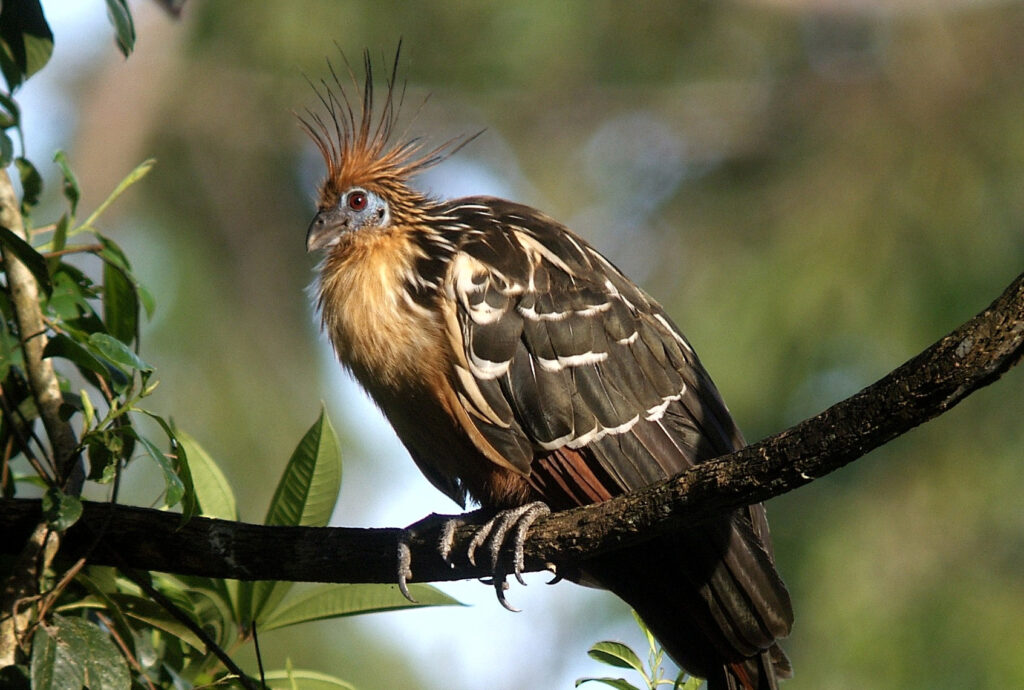
In the slow-moving rivers and swampy oxbows of the Amazon and Orinoco basins, a bird exists that looks like it forgot to evolve—or evolved in a direction no one else dared. This is the Hoatzin (Opisthocomus hoazin).
Quite common where it lives, it’s not hard to find a group. You might hear it first: a raspy, grunting cough from the riverbank, like an old engine struggling to start. Then the dense foliage stirs and out comes a prehistoric silhouette—long-necked, blue-faced, red-eyed, with a punk crest erupting from its head like a botanical explosion. It moves awkwardly through the branches, flapping in slow motion, wings more useful for balance than flight. And when it opens its beak to call again, the sound reminds you: this is no ordinary bird.
And indeed, it isn’t.
An Evolutionary Outlier
The Hoatzin’s family tree is a lonely one. Its order—Opisthocomiformes—has no close relatives, and molecular studies have shuffled it around the avian phylogeny like a taxonomic orphan. It doesn’t fit neatly anywhere. This bird diverged early, and it shows.
Take its young. Hatchlings are born with functional claws on their wings, which they use to climb through the tangled vegetation like miniature raptors. This trait evokes fossil birds like Archaeopteryx, raising goosebumps among evolutionary biologists and Jurassic Park enthusiasts alike. But the claws are gone by adulthood—just a temporary relic, like a secret whispered by the genome.
Then there’s the digestion. The Hoatzin is the only known bird that ferments its food like a cow. Its oversized crop hosts a thriving microbiome that breaks down the fibrous leaves it feeds on—a rare and inefficient diet for a bird, but one that ties the Hoatzin inextricably to the flooded forests it inhabits. The fermentation makes it smell… bad. Some call it the “stinkbird.” Locals rarely hunt it.
A Bird Bound to Forests
In ecological terms, the Hoatzin is a specialist of seasonally flooded forests—várzea, igapó, and swampy margins of oxbow lakes. These are forests that pulse with water and decay, and the Hoatzin thrives in the mess, nesting in thickets over water where predators have trouble reaching them.
This narrow ecological niche makes the species highly sensitive to changes in hydrology and forest integrity. Deforestation along riverbanks, damming of floodplain systems, or fire-induced conversion of wetlands can fragment their habitat. The species is very sensitive to burning forests, and disorientation, group behaviour could lead dozens to a premature end.
They aren’t endangered, at least not yet, but they are indicators of something older and more delicate: the health of a disappearing biome, one that floods, decomposes, regenerates, and sustains. Conservation ideas focused on maintaining the larger diversity of genetic traits, and for this reason, the Hoatzin is certainly one of those great species that bring attention to its future.
More Than a Curiosity
It would be easy to dismiss the Hoatzin as a novelty—a weird bird for trivia lists. But that misses the point. The Hoatzin is not just a biological quirk; it is a living archive. A reminder that evolution doesn’t always follow the rules, that survival sometimes means smelling bad, and that beauty doesn’t have to be sleek or symmetrical.
In the context of forest conservation, the Hoatzin represents something else: resilience through specialisation, and vulnerability through dependency. It reminds us that preserving a forest isn’t just about keeping the trees standing. It’s about keeping the flood pulse intact, the microbial life thriving, and the strange, unforgettable birds climbing awkwardly through the branches, grunting like ancient machines.
Protecting the Hoatzin means protecting the ecological grammar of flooded Amazonian forests. It means valuing the obscure over the obvious and listening to the parts of nature that cough and climb and ferment quietly at the forest’s edge. And perhaps, in doing so, we come closer to understanding how much strangeness we must preserve if we are to keep the world alive.
At our conservation projects and areas in Brazil, the presence of Hoatzins is a sign that certain forest functions are still intact: canopy-riparian connectivity, aquatic-terrestrial linkages, and seasonal productivity. More than that, we are helping to keep common birds common.
Photos courtesy of Dr. Gerard Bertrand
For more news click HERE
Permian Brazil HERE