




The Black Curassow (Crax alector), a totemic bird of Amazonian and Guianan forests, carries within its biological and cultural history a series of remarkable traits that make it a unique cracid. Its life expectancy in captivity surpasses 20 years, in stark contrast with its reality in the wild, where it rarely reaches such longevity due to hunting pressure. Its bones, hollow yet denser than those of other frugivorous birds, give it a heavy and almost “terrestrial” gait, favoring ground movement over flight. Even with broad wings, it seldom uses them for prolonged flights; instead, it opts for short, explosive bursts, which makes it particularly vulnerable to traps and hunting with dogs.
In terms of mobility, within Amazonian and Guianan forests, the Black Curassow typically covers 500–800 m daily in irregular trajectories while foraging for fruits along trees and riverbanks. During fruiting peaks of palms such as Attalea, its movements shrink to radii of only 200–300 m, but in leaner seasons it may expand its range to 1–2 km in a single day.
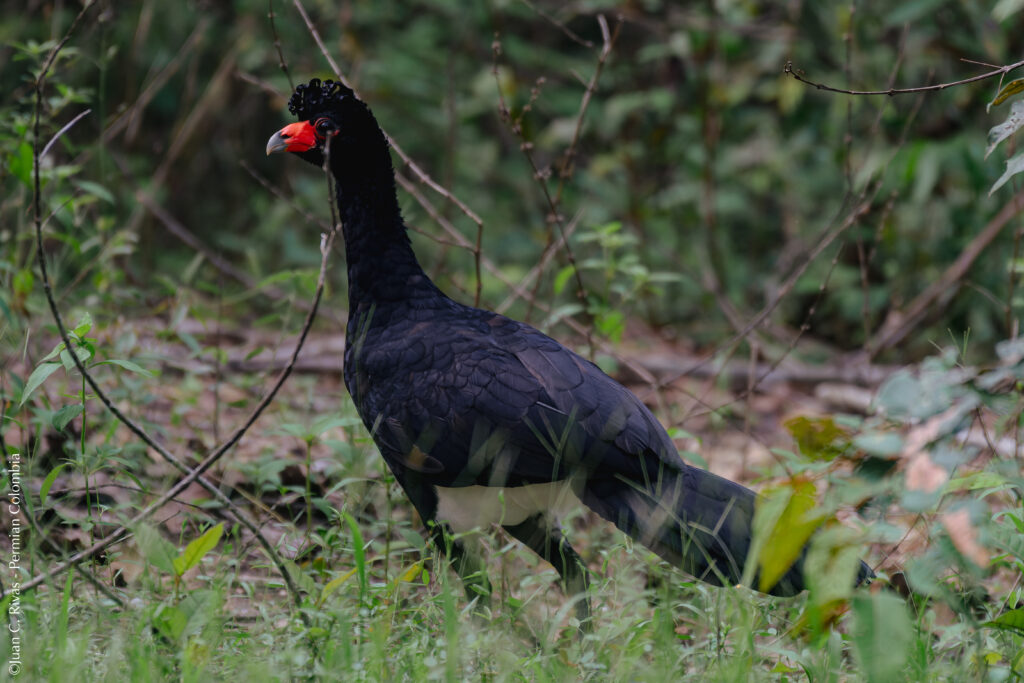
Its reproductive strategy is equally distinctive: it lays small clutches of 1–2 eggs in precarious branch nests, often at low heights, which exposes them to predators. For Indigenous communities, this behavior is a metaphor of trust in the forest: “if the curassow lays its young close to the ground, it is because it trusts the forest to protect them.” Moreover, its “rumination-like” behavior sets it apart from other birds: after ingesting large fruits, it retains them in the crop for long periods and, on occasion, regurgitates the intact seeds in clearings, fostering the formation of seed banks that contribute to forest regeneration and restoration.
Acoustically, males emit a low-frequency vocalization (<40 Hz), barely perceptible to the human ear, which seems to function as a long-range territorial signal. Some researchers compare it to the infrasounds of tapirs and elephants—a rare trait among birds that further underscores its uniqueness.
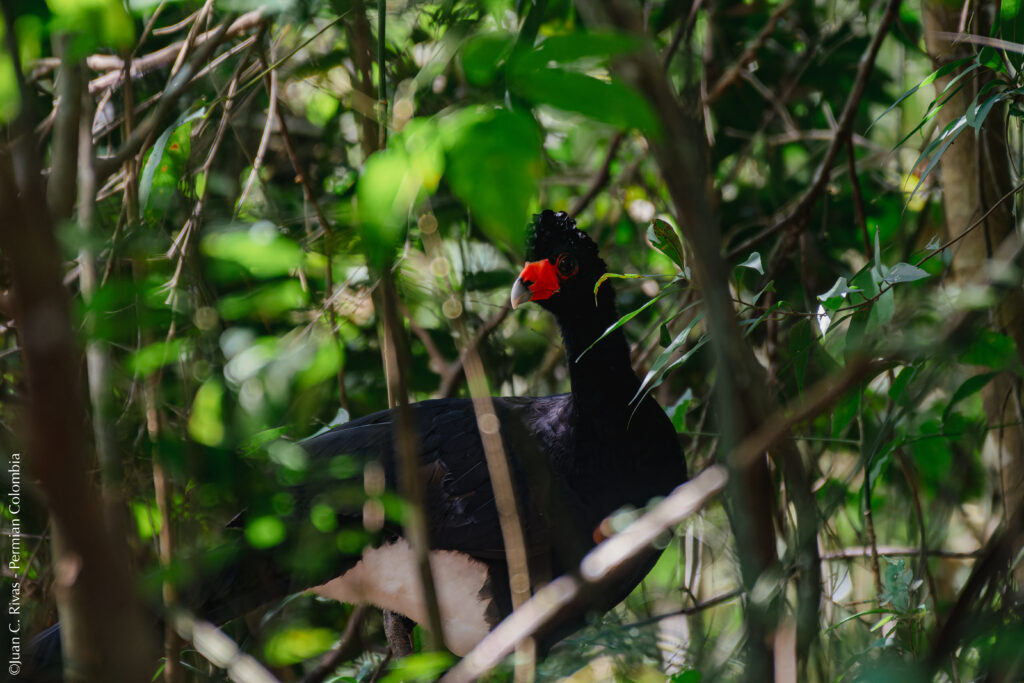

From an evolutionary perspective, although Crax alector is globally classified as Least Concern (LC) by the IUCN, isolated populations display genetic and morphological differences suggestive of poorly studied divergence processes. Some authors even suggest the existence of cryptic subspecies in the Guiana Shield. Recent research has identified significant divergences between Amazonian and Guianan populations, hinting at unrecognized processes of evolutionary substructuring and raising questions about its adaptive variability and the potential existence of distinct lineages within the species.
This knowledge highlights the urgency of protecting local populations and maintaining habitat connectivity, as each population nucleus could represent a unique genetic reservoir. In Colombia, where the Black Curassow faces increasing threats from deforestation and hunting, confirmed records within the Guayabero Crocodile Reserve (La Macarena, Meta) reinforce the value of these transitional refuges between the Orinoquía and the Amazon. They are not only essential to ensuring the species’ persistence but also to unlocking the evolutionary and cultural keys still held by this enigmatic Neotropical cracid.
References
Delacour, J., & Amadon, D. (2004). Curassows and Related Birds. Lynx Edicions / American Museum of Natural History.Strahl, S. D., & Grajal, A. (1991). Conservation of large avian frugivores and the management of Neotropical protected areas. Oryx, 25(1), 50–55.Brooks, D. M., & Strahl, S. D. (Eds.). (2000). Curassows, Guans and Chachalacas: Status Survey and Conservation Action Plan for Cracids 2000–2004. IUCN. Santos, F. et al. (2015). Home range and movement patterns of curassows (Cracidae) in Amazonian forests. Journal of Ornithology, 156(2), 373–386. Wallace, R., & Painter, R. L. (1999). Movement ecology of cracids in seasonal forests of Bolivia. Ecotropica, 5, 55–68. Muñoz, M. C., & Kattan, G. H. (2007). Diet and seed dispersal by the great curassow (Crax rubra) in Colombian forests. Biotropica, 39(4), 603–609. Hill, J., & Plowman, A. (2002). Ethno-ornithological traditions of Amazonian peoples. Journal of Ethnobiology, 22(2), 197–221. Bodmer, R., Eisenberg, J. F., & Redford, K. H. (1997). Hunting and the likelihood of extinction of Amazonian mammals. Conservation Biology, 11(2), 460–466. Brooks, D. M. (2006). The utility of low-frequency vocalizations in large Neotropical cracids. Ornithological Monographs, 60, 73–88. IUCN (2023). Crax alector. The IUCN Red List of Threatened Species 2023. Ferreira, A. B. et al. (2020). Genetic divergence among populations of Black Curassow (Crax alector) in Amazonia and the Guiana Shield. Conservation Genetics, 21(5), 789–801.
Read about the Guayabero Cocodrilo Reserve – Permian Global
For more news click HERE